01
Keeping options open
Why wait to declare?
Why, courted by the Eastern Army from early on, did he not declare for it until the fighting had begun?
A historical reinterpretation: Betrayal as Strategy
In 1600, the armies of Japan met at Sekigahara to settle who would rule the country. The winner's house would govern for the next two and a half centuries. On a hill above the field sat Kobayakawa Hideaki, eighteen years old, with 8,000 men. Soon after the fighting began, he turned on the side he had marched with, and the battle was over within hours. History remembers him as a traitor who could not make up his mind. This novel keeps every event as the sources record it — and asks whether he had in fact made up his mind long before.
01
Sekigahara, 1600, was the battle that settled who would rule Japan after the death of Toyotomi Hideyoshi, the ruler who had unified the country. On one side stood Tokugawa Ieyasu; on the other, the Western Army, a coalition of lords fighting in the name of Hideyoshi's young son. Ieyasu's victory opened the way to two and a half centuries of Tokugawa rule.
Kobayakawa Hideaki had grown up in Hideyoshi's household, as his adopted son and a nephew of his wife, and as a boy, it is thought, was placed where he could stand in for Hideyoshi himself. By 1600, at eighteen, he was lord of two provinces in northern Kyushu and head of the Kobayakawa house. At Sekigahara he stood with the Western Army; instead he turned his 8,000 men against it, and the Western Army was routed within the day. In Japan, his name has stood for "traitor" ever since.
The story everyone tells goes like this: "An irresolute young man wavered until the day of the battle, and when Ieyasu's guns were turned on him he took fright and betrayed the Western Army."
The volley this story turns on does not appear in any contemporary source. It first surfaces in Edo-period chronicles and family histories. Set that story aside, follow the surviving events in the order they happened, and a different figure comes into view.
Why, courted by the Eastern Army from early on, did he not declare for it until the fighting had begun?
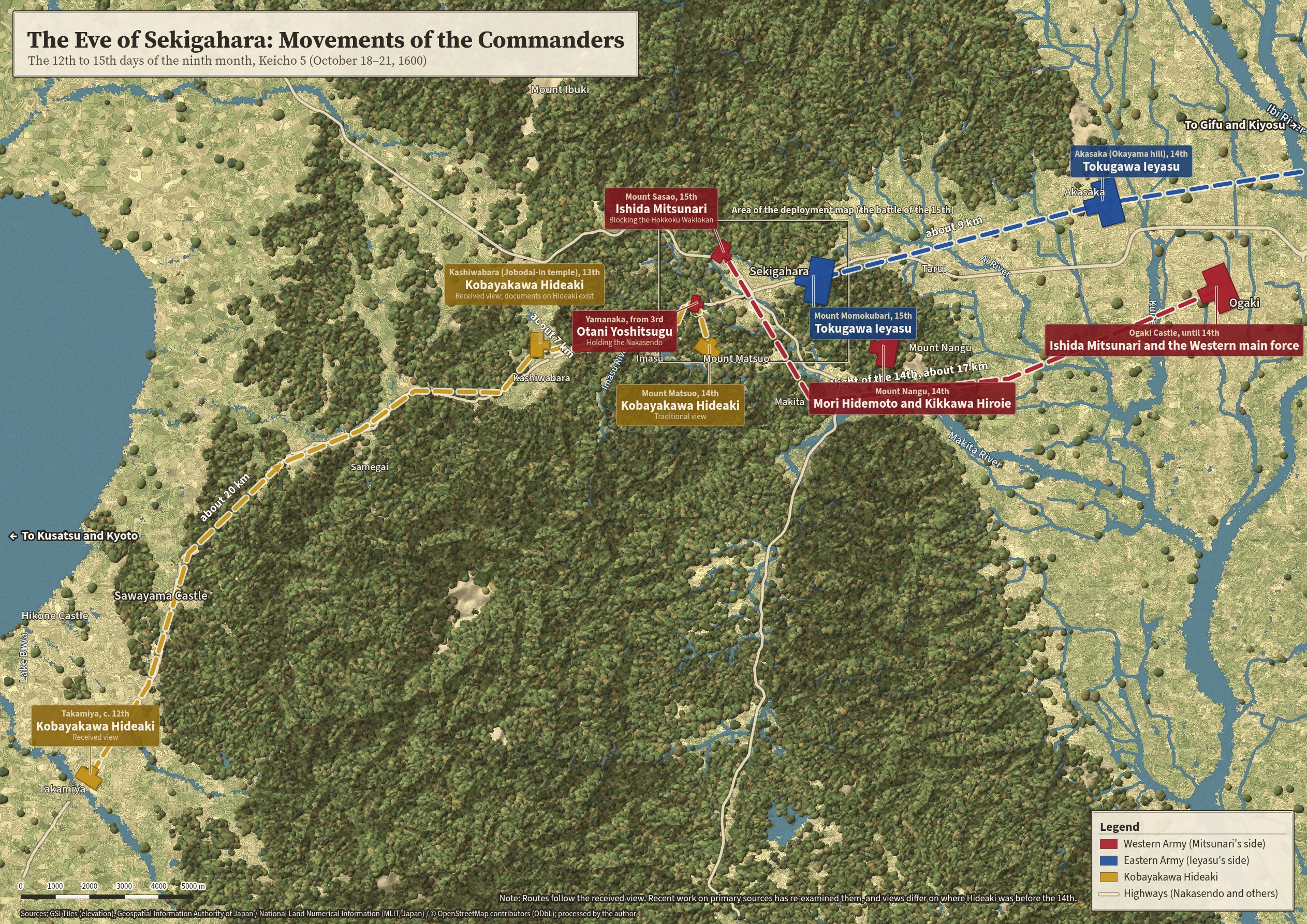
Why was he on Mount Matsuo, ahead of the Western Army's main force, on the very day Ieyasu reached Akasaka?
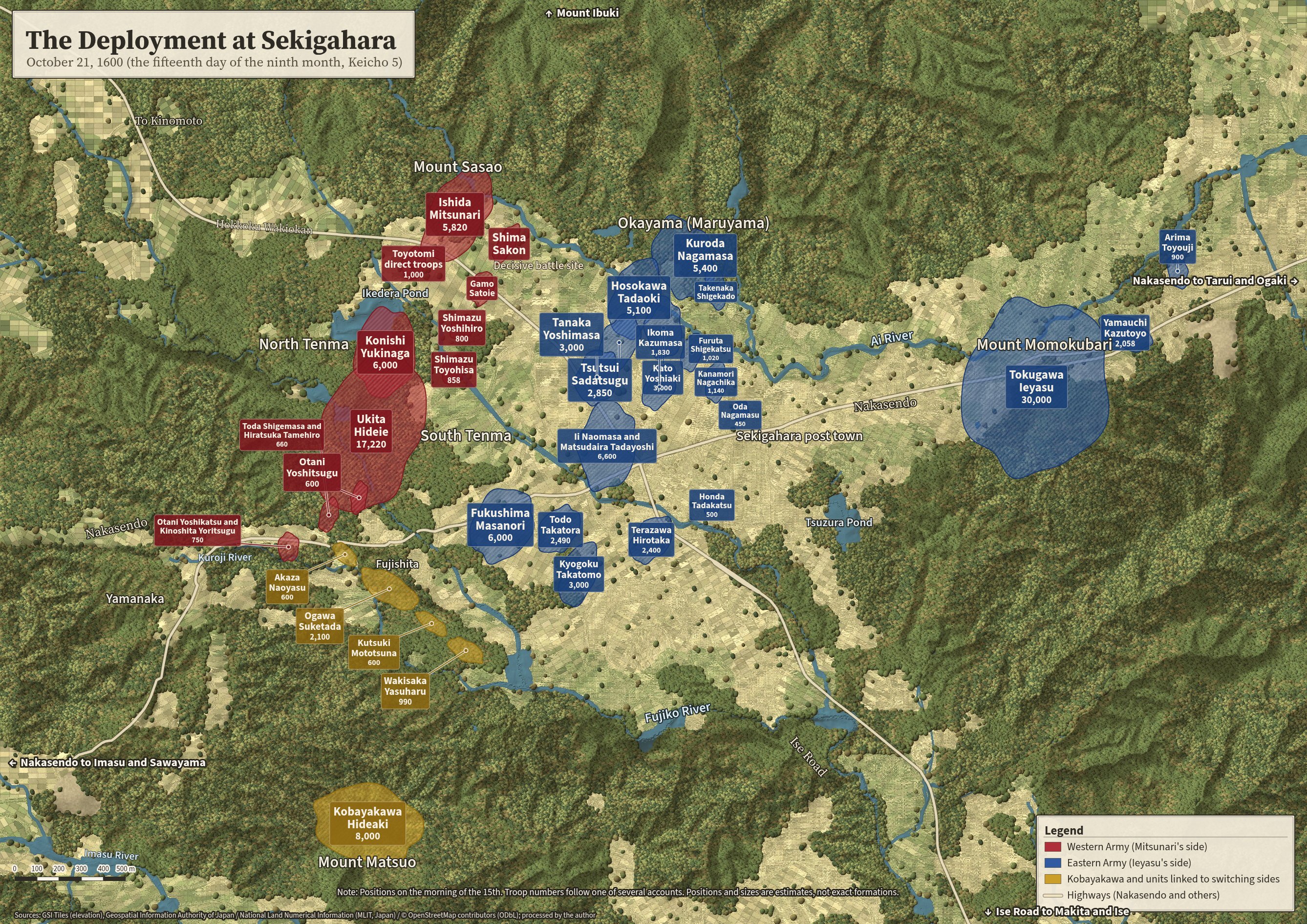
Why are the four houses under Wakisaka and the others, drawn up between him and Otani, said to have changed sides together just as he moved on Otani?
The book's hypothesis
Taken one at a time, each can be explained as chance.
Explain them all as chance, and the coincidences have to be piled one on another.
This book rereads them as the decisions of a strategic genius who made the right call at each turn. Analysis I sets out that reasoning step by step in the language of game theory, and Analysis II tests it against the sources and the other explanations. The book does not claim to prove what Hideaki was thinking. It sets out a model of his decisions and every assumption behind it; on that model, he reads as a strategic genius. Anyone who disagrees can show exactly which premise fails — the assumptions and the evidence are all set out in Evidence C.
At each turn, the Hideaki of this book made the right call from what he could see. What he settled in advance was a broad course — side with the Eastern Army, but do not declare it early — together with his own decision on how far Ieyasu had to come before he moved. Beyond that, he held back the moves that could not be taken back until the conditions were right, and chose the next one only after seeing what the other side did.
02
Analysis I does not explain Kobayakawa Hideaki by verdicts on his character — that he was indecisive, or that he was bold. It rereads each decision in turn by asking who decided, what they knew, which moves were open to them, and how a move changed the moves open to the other side.
The book reads Hideaki's decisions in three stages.
What to decide now, and what to leave undecided for the time being. — Chapters 1 and 2, Analysis I-2 to I-4
How moving first himself changes the moves open to the other side. — Chapters 3 and 4, Analysis I-5 and I-6
When and how to bring about the moment at which the other side has no choice but to decide. — Chapters 5 and 6, Analysis I-7 to I-9
03
In the order things happened: first Hideaki's own actions, then the situation he was placed in. Each answer ends with the chapter and section of the book that deal with it.
First, Hideaki's own actions.
Hideaki treats deciding which side to take and deciding when to say so as separate moves. Declare for the Eastern Army, and from that day he would be treated as an enemy in the middle of the Western Army and shut out of key positions. While he said nothing he could move as a Western Army lord, and if Ieyasu never came west he could simply remain a Western Army lord. — Chapter 2, Analysis I-4
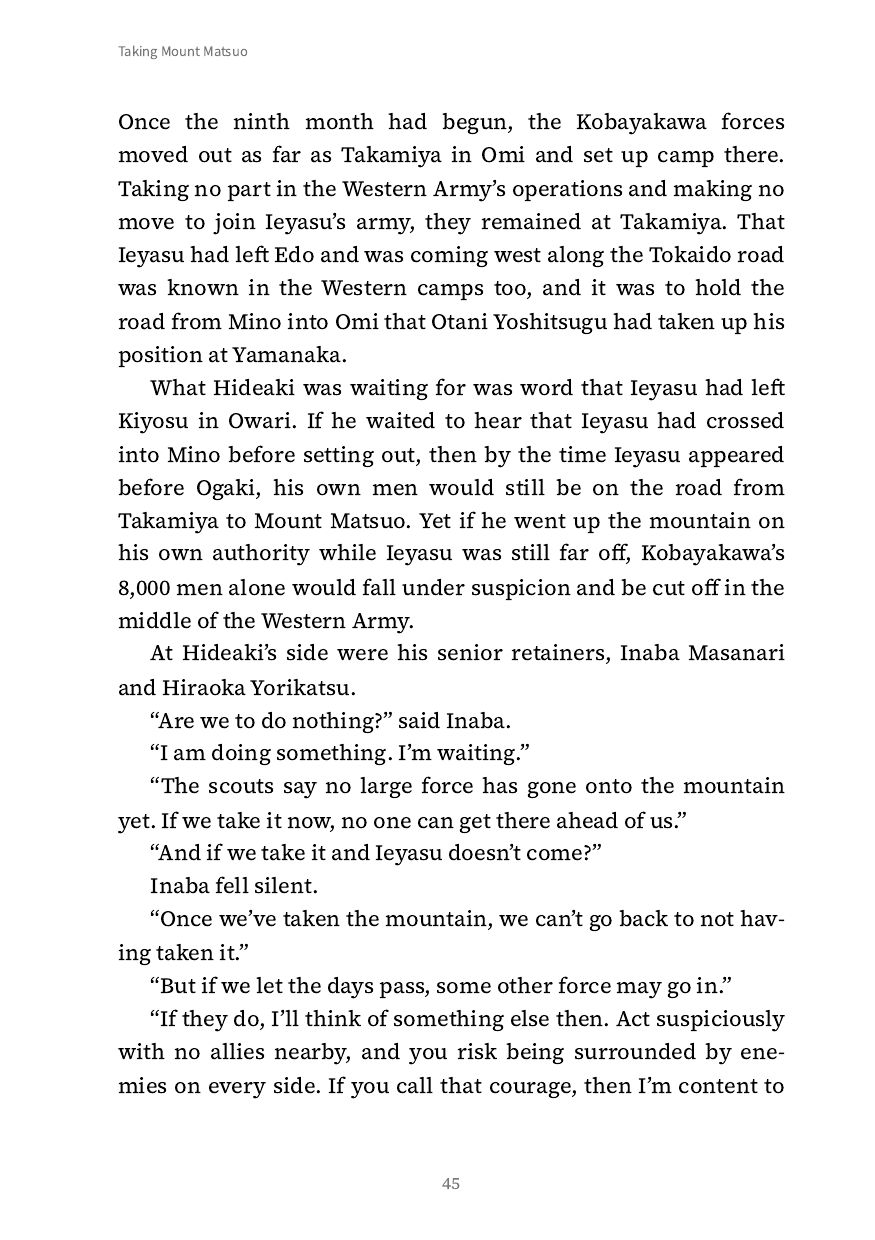
In this book, without orders from Mitsunari, Hideaki went onto Mount Matsuo, a height the Western Army regarded as important, ahead of the Western Army's main force. The mountain looks down from the side on the Nakasendo, the road on which the Western Army at Ogaki depended for its provisions and for its communications with Osaka. Once 8,000 men were on it, a political question that could be put off — east or west — became a battlefield question that could not: who is in trouble the moment someone else moves. — Chapter 3, Analysis I-5
Some scholars, working from contemporary sources, put the opening of the battle at about ten in the morning, with the Kobayakawa changing sides almost at the same time and the Western Army collapsing very quickly. This book follows that reading: Hideaki sends his vanguard straight at Otani as the battle opens, and commits the rest only after seeing the four houses at the foot of the mountain change sides and follow the vanguard toward Otani. The point was to break Otani before the Mori on Mount Nangu could come down. What he had been delaying was not the decision but the moment of declaring it, and on that reading the speed makes sense. — Chapter 6, Evidence C-5
Next, the situation he was placed in.
That Ieyasu reached Akasaka on the fourteenth day of the ninth month is confirmed by a letter written two days after the battle, and the Kobayakawa are said to have gone onto Mount Matsuo the same day. That the side coming from Edo and the side waiting in Omi arrived on the same day at positions flanking the battlefield, this book does not take for chance: it reads Hideaki as moving on conditions he had set himself (to begin to act once Ieyasu left Kiyosu, and to go onto Mount Matsuo). The Story depicts those conditions as agreed with Ieyasu's side in advance. No document showing such an agreement is known, so this is the book's assumption. Between the Okayama hill at Akasaka and Mount Matsuo lies the ridge of Mount Nangu, so neither camp could see the other. At this point Hideaki sent no envoy to Ieyasu; Ieyasu's side counted the days from Kiyosu, sent out a scout, and confirmed only that a force had gone onto the mountain. — Chapter 3, Evidence C-8
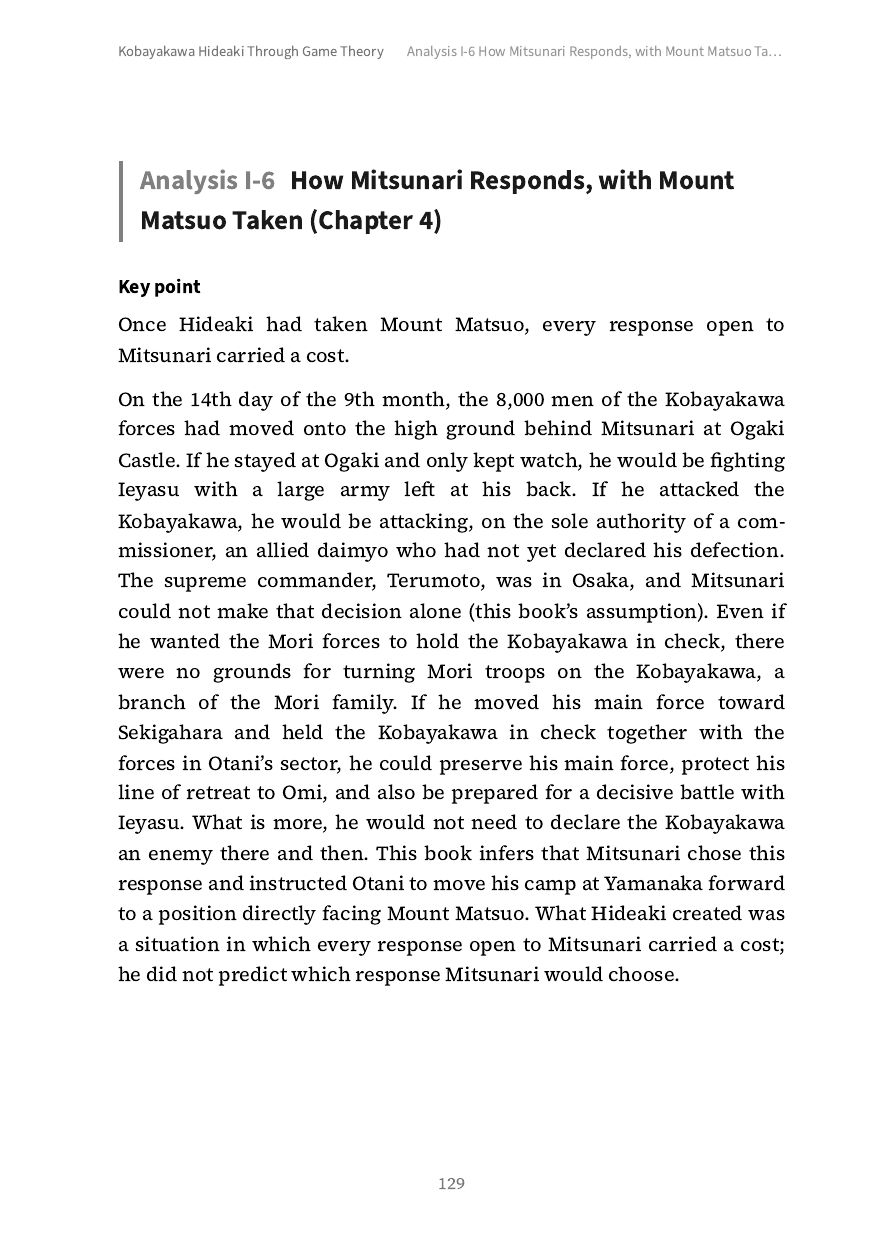
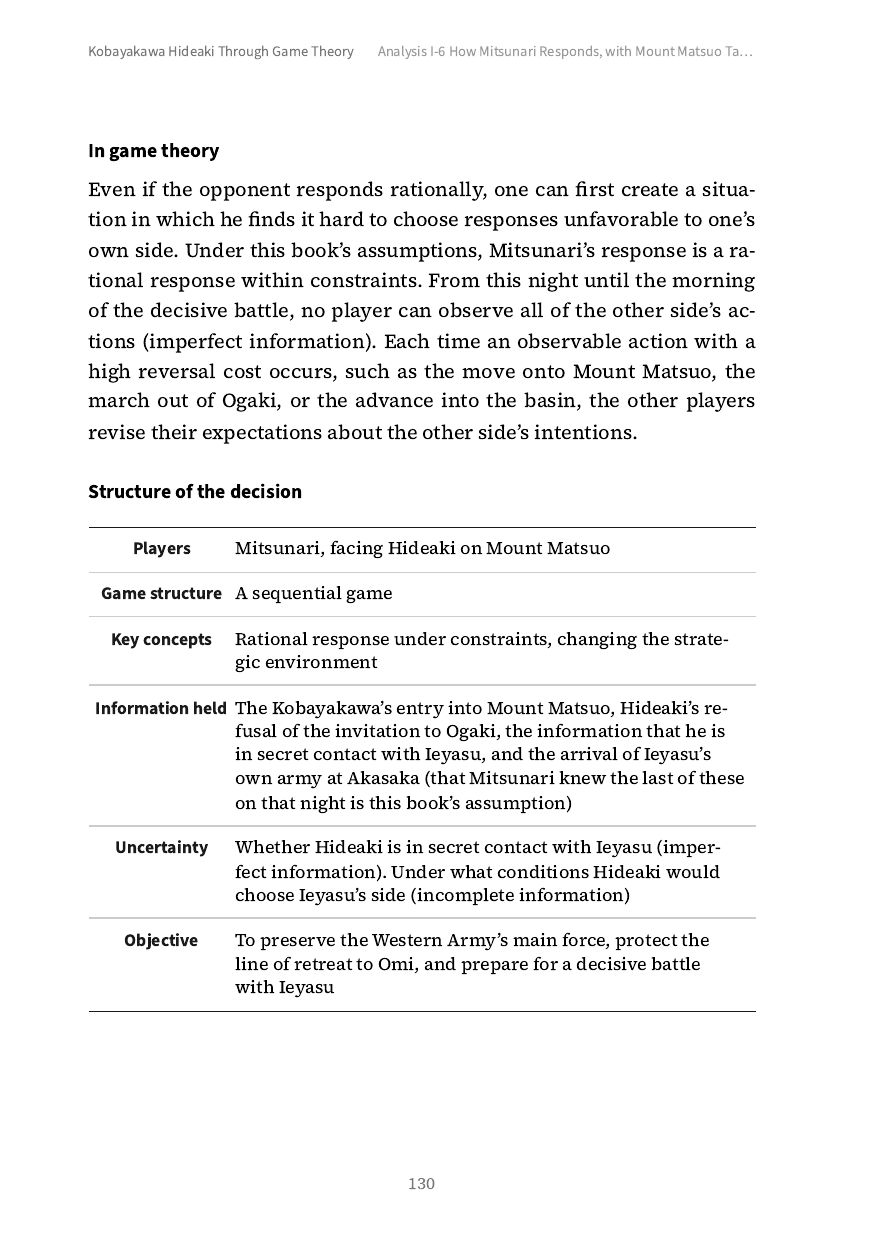
The Mitsunari of this book leaves Ogaki because a force he had not counted among those who were to come round behind had taken the very ground he had meant for them. To declare Kobayakawa an enemy would make 8,000 men a formal enemy at Otani's back — and Mitsunari, a commissioner, could not, on his own authority, find a lord of 500,000 koku who had not yet changed his colors guilty of rebellion and have him attacked. So he moves the main force to Sekigahara not to seek a decisive battle but to keep Otani from being isolated. — Chapter 4, Analysis I-6
This book reads it this way: on the night he decided to move to Sekigahara, Mitsunari sent word to Otani to bring his camp round to face Mount Matsuo. If anyone was to stand in front of the Kobayakawa, there was no one but Otani, the most loyal and the least likely to break in the whole Western Army. This arrangement — the south held in Otani's sector, Mitsunari himself taking the Eastern Army head-on from Mount Sasao in the north — is written here as a rational move on Mitsunari's part, one that allowed even for being betrayed by the Kobayakawa. — Chapters 4 and 5, Analysis I-6
The four houses were not part of Otani's own force. Each was an independent lord's house. Before dawn on the day of the battle, the Hideaki of this book sends separate envoys to the four houses, tells each that the Kobayakawa will move forward on Otani and that each house must decide for itself which side to take, without saying when, and asks for no reply. The moment the Kobayakawa move, every one of the four faces the same choice at the same time: stay in the path of 8,000 men, or follow the Kobayakawa against Otani. That Wakisaka and Ogawa are said to have been in secret contact with the Eastern Army beforehand makes it easier for them to turn, but the moment itself, this book reads, was made by the Kobayakawa. — Chapters 5 and 6, Analysis I-7 and I-8
04
One passage each from the narrative, the analysis and the evidence. Turn the pages of the same passage in the paperback or on Kindle.
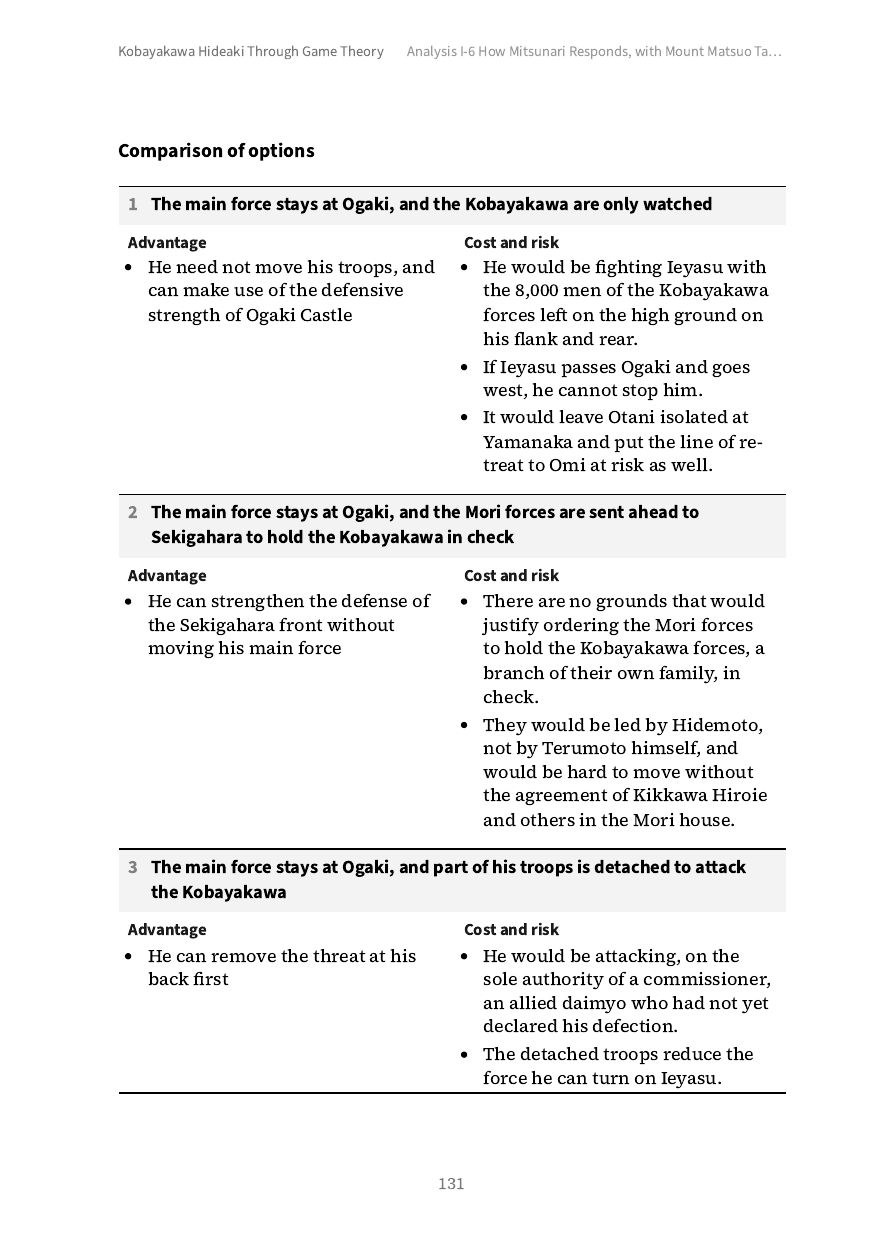
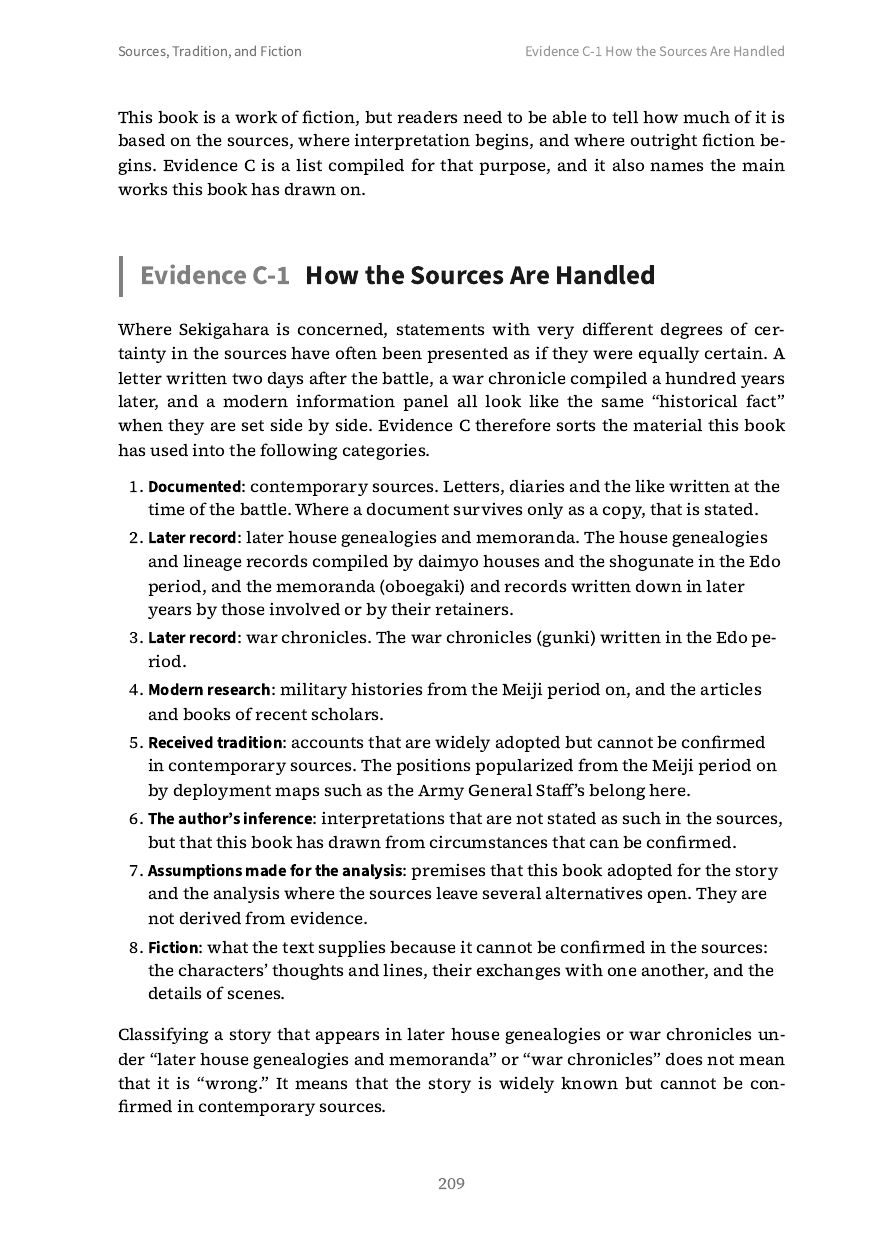
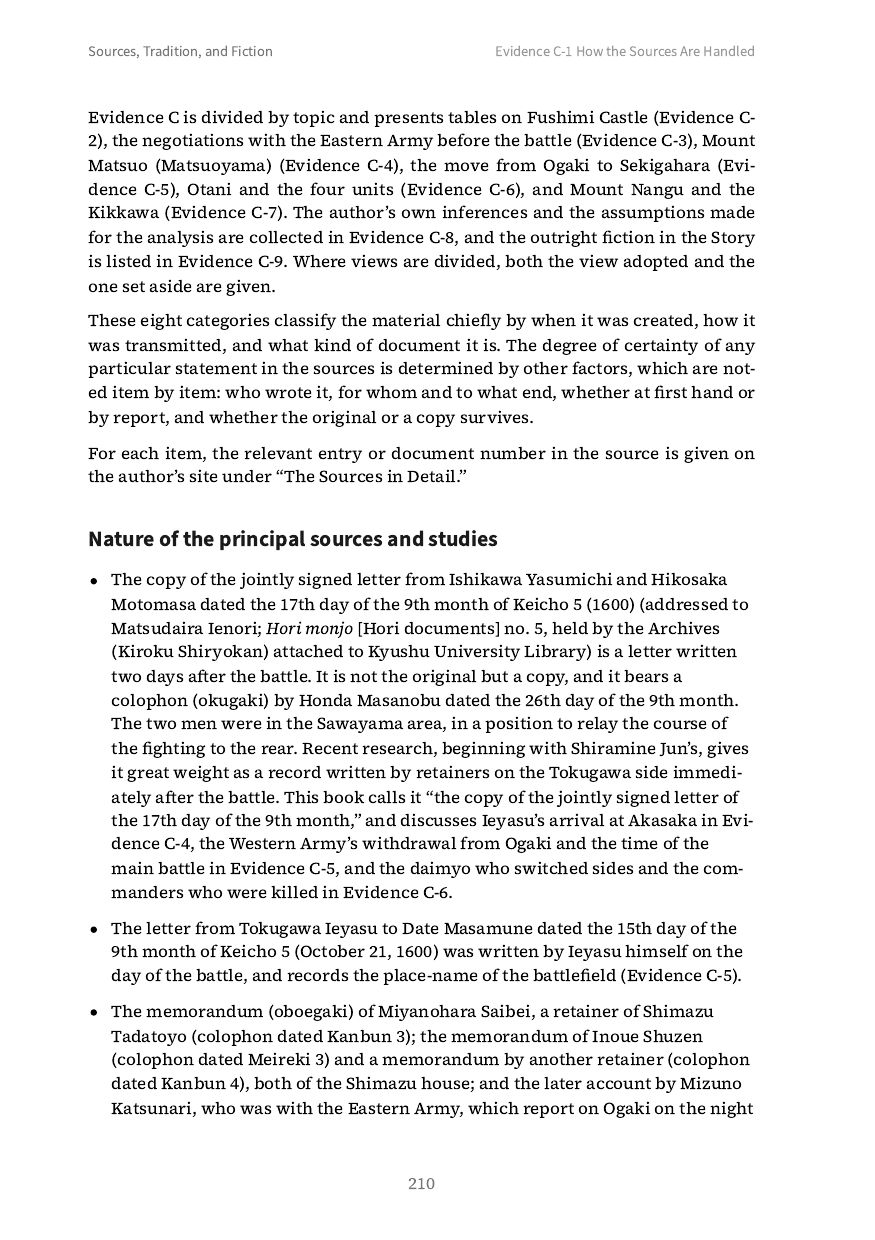
05
Behind the narrative are an analysis section that takes the decisions apart and an evidence section that gathers the material for checking them.
The Narrative
How treating each of Hideaki's actions as chance piles coincidence on coincidence, how that led to the hypothesis that he acted deliberately, and the search for facts that would break it.
Put in command of the siege of Fushimi, Hideaki watches a morning when the other houses' men do not turn out as ordered, and concludes that what the Osaka side lacks is not troops but someone who decides what, and when.
Comparing a Western Army of many masters with an Eastern Army where Ieyasu alone decides, he settles on Ieyasu — and says nothing, and sends no written reply.
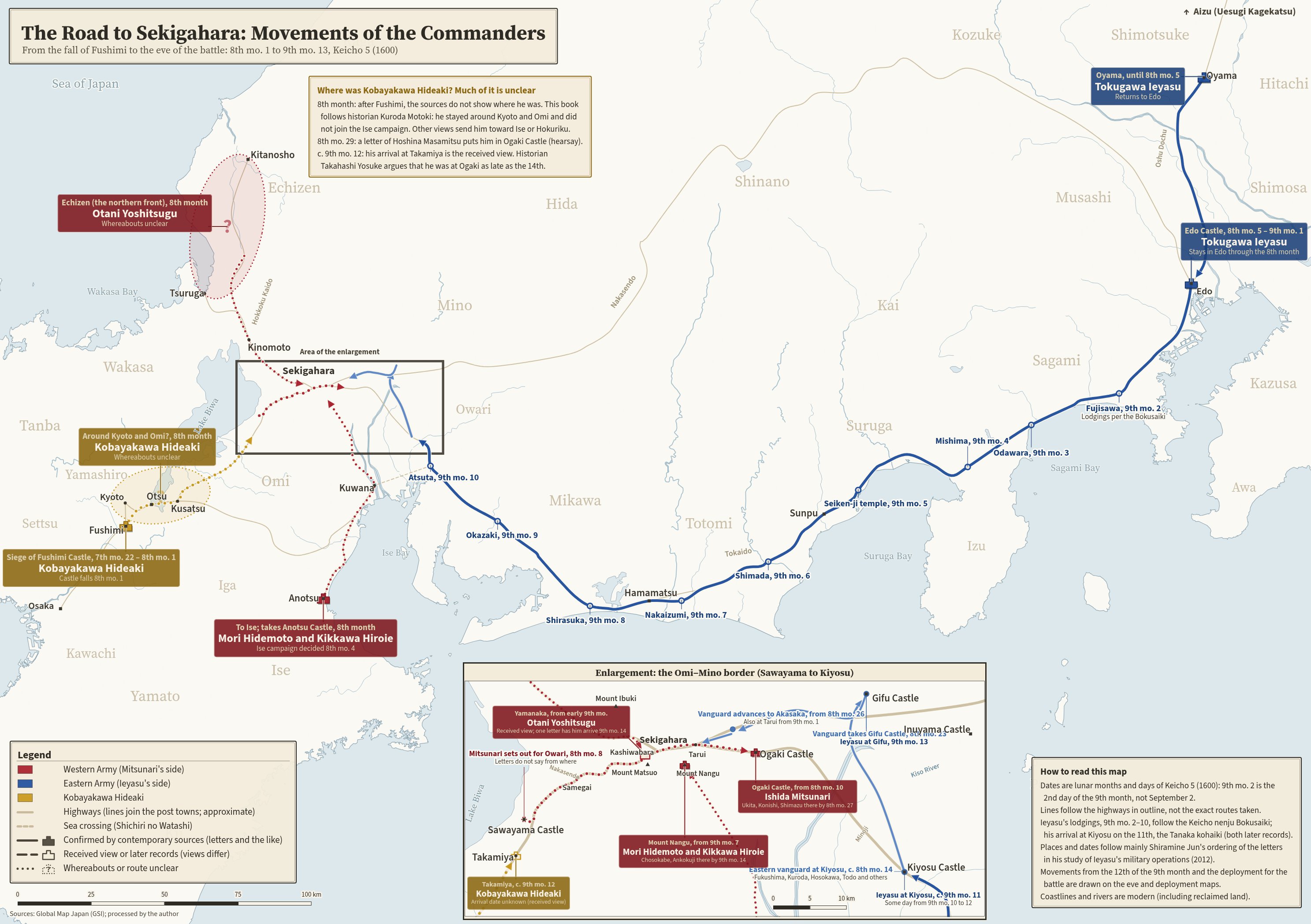
Hearing that Ieyasu has left Kiyosu, he leaves Takamiya; he waits at Kashiwabara, and when word comes that Ieyasu has entered Gifu he moves on Mount Matsuo, making Ito Morimasa's men withdraw without a fight.
Unable even to declare the 8,000 men on Mount Matsuo an enemy, Mitsunari leads the main force out of Ogaki in the night so that Otani will not be left isolated.
With the two armies facing each other in the basin and a battle now certain, Hideaki decides to move on Otani and sends separate envoys to the four houses between them: the Kobayakawa will advance on Otani, and each house must decide for itself which side to take.
As the battle opens he sends his vanguard at Otani, and once the four houses have cleared the road and turned, he throws everything he has at Otani.
Moved to Bizen and Mimasaka after Sekigahara, Hideaki dies at Okayama two years later, and the Kobayakawa house comes to an end.
Do you do your best inside the camp you have been given, or do you choose for yourself which camp to join? The difference between Mitsunari and Hideaki, set out as a question about work and organizations today.
Analysis
The decisions of Chapters 1 to 6, sorted into three stages — keeping options open, narrowing the opponent's options, and forcing the opponent to decide — and set out in the language of game theory.
For four questions — why he kept his allegiance hidden, whose decision it was to enter Mount Matsuo, what brought the four houses into motion together, and whether his taking the mountain affected the Western Army's move to Sekigahara — the book's hypothesis and the other explanations are compared by how reliable the sources are and what each explanation cannot do without, to see which accounts for the events most naturally. If the model holds, Hideaki can be judged a strategic genius.
Evidence
Home province, koku and strength for every unit in the deployment map; movements from the seventh month to the fifteenth day of the ninth; and distances along the roads, with a note on how to read the map.
A chronology, and what can be established about his upbringing inside the Toyotomi house, the crossing to Korea, his senior retainers, and the government of Chikuzen and of Bizen and Mimasaka.
The material this book draws on, sorted from contemporary documents through to invention, and set out point by point from Fushimi to Mount Nangu: how far the sources reach, and where inference, assumption and invention begin. The principal works consulted are listed here too. Which entry or document number of which source each item rests on is set out on this site under The Sources in Detail.
Kindle and Paperback
Betrayal as Strategy: Kobayakawa Hideaki and the Game Theory of Sekigahara