Press · Betrayal as Strategy
A new reading of Sekigahara, Japan 1600: the betrayal that decided the battle, reinterpreted as strategy
A historical novel reconstructs the Battle of Sekigahara from one young lord's decisions, using the sources and game theory. Published in English and Japanese on the same day.
Betrayal as Strategy: Kobayakawa Hideaki and the Game Theory of Sekigahara by Sagara Sei tells the story of the commander whose change of sides decided Sekigahara, and reads him not as a young lord pushed into betrayal but as one who chose his own ground and his own moment. The Kindle edition is published in English and in the original Japanese on October 2, 2026.
- Kindle edition Available for pre-order (releases October 2, 2026) US$5.99 Pre-order on Kindle
- Paperback Coming mid-October 2026 Expected price US$12.99
For interviews, image permissions and review copies, write to press@sagara-sei.com.
Press release
A New Reading of Sekigahara, Japan 1600: The Betrayal That Decided the Battle, Reinterpreted as Strategy
Sagara Sei publishes Betrayal as Strategy: Kobayakawa Hideaki and the Game Theory of Sekigahara on Amazon Kindle on October 2, 2026, in English and in the original Japanese (裏切りの戦略). A paperback edition follows (Coming mid-October 2026).
Sekigahara, and the question historians have asked
In 1600 the Battle of Sekigahara decided who would rule Japan, and one commander's change of sides decided the battle. Kobayakawa Hideaki, eighteen years old, held Mount Matsuo (Matsuoyama) above the field with 8,000 men. He has long been remembered as an indecisive traitor who changed sides only when Tokugawa Ieyasu's guns fired on his position. That episode, the "probing shots" (toi-deppo), does not appear in contemporary sources, and research has treated it as a later invention. Historians have asked who put Hideaki on Mount Matsuo — the Western Army, or Ieyasu's side — and when he began dealing with Ieyasu. No contemporary document ordering him onto the mountain survives from either side.
The hypothesis: why assume anyone put him there?
The book steps back from that question. A lord commanding his own army needs no one else's order to move it. The book assumes that Hideaki, watching Ieyasu advance west, chose the place and the moment himself.
What the hypothesis shows
From that assumption, the book rebuilds the forces, the terrain, the positions of every unit, Ieyasu's progress and the four houses below the mountain. It treats Sekigahara as a strategic game: who decided, what each side knew, which moves were open, and how one move changed the moves open to the other side. Keeping his allegiance from the Western Army until the day of the battle, taking Mount Matsuo, and moving on Otani Yoshitsugu the moment the battle opened then read as one line of decisions, made to keep his house alive. On this model, Hideaki was not a hesitant youth but a strategic genius who made the right call at each turn.
Evidence and inference, kept apart
The book claims no new sources. It keeps every event the sources record, infers the decisions the sources alone cannot settle, using game theory and decision-making under uncertainty, then tells them as a novel. The story follows Hideaki's actions in order; the Analysis explains why he chose each one and tests that reading against other explanations and the sources; the Evidence section marks where contemporary documents end and later records, modern research, received tradition, the author's inference and assumptions, and fiction begin.
Publication details
| Title | Betrayal as Strategy: Kobayakawa Hideaki and the Game Theory of Sekigahara |
| Japanese edition | 裏切りの戦略──再考・小早川秀秋 |
| Author | Sagara Sei (相良 静) |
| Kindle edition | Available for pre-order (releases October 2, 2026), US$5.99 |
| Paperback | Coming mid-October 2026, Expected price US$12.99 |
| Book page | https://sagara-sei.com/en/books/sekigahara/ |
About the author
Sagara Sei rereads historical decisions through strategy, institutions and the structure of games.
Press contact
Sagara Sei, press@sagara-sei.com
Story angles
- Was Kobayakawa Hideaki really indecisive?
- What changes when Sekigahara is modeled as a strategic game?
- Decision versus action: why a delayed move does not necessarily mean hesitation
- How the ground itself shaped Hideaki's choices — and Ishida Mitsunari's
- How far can historical fiction reconstruct decisions the sources alone cannot settle?
Key points
- Deciding, declaring and moving are treated as separate choices. Hideaki declared for the Eastern Army before the Western Army only on the day of the battle; the book reads this not as indecision but as a choice to keep his side hidden from them
- What the sources cannot settle is marked as open, and a decision model is set on it as a hypothesis. Every assumption the model makes is set out in the Evidence section (Evidence C-8)
- Each player is described by what he knew and what he could choose. Hideaki, Mitsunari, Ieyasu, Otani and the four houses below the mountain, each with its own aims, information and options
- The terrain is checked. The book draws Sekigahara as it could be seen on the morning of the battle from three camps, using elevation data from the Geospatial Information Authority of Japan (the map "The View from Three Camps" at the end of Chapter 5; the terrain is as it is today). From Mount Matsuo, Ieyasu's headquarters at Akasaka lay hidden behind Mount Nangu
- The inference becomes a novel, and the grounds stay in the book. The story reads on its own, but a reader can always check where the sources end and the inference begins
Method
The book does not rewrite history. It infers the decisions left open between the recorded events and tells them as a novel. It works in six steps:
- Fix the events the sources confirm
- State which interpretations from existing research it adopts
- Leave open what the sources cannot settle
- Set out, for each lord, his aims, what he knew and what he could choose
- Build a line of decisions that contradicts no source
- Tell that line of decisions as a novel
It keeps its material in three layers:
| Layer | What it is | How the book treats it |
|---|---|---|
| Sources | Events confirmed by contemporary documents | Not changed |
| Research and received views | Historians' interpretations and widely held accounts | Those adopted are named in the Evidence section |
| Decision model | Judgments the sources alone cannot settle | The author's inference; every assumption is written out in the Evidence section |
Contents
The Story Introduction / 1 The Castle That Would Not Fall / 2 Siding with the East / 3 Taking Mount Matsuo / 4 The Western Army Leaves Ogaki / 5 Turning the Defensive Line / 6 Concentrating Force at One Point / Two Years Later / How This Book Reads the Story
The Analysis I Kobayakawa Hideaki Through Game Theory / II Testing the Book's Hypothesis
The Evidence A The Situation, the Forces, and the Positions / B Kobayakawa Hideaki in the Historical Record / C Sources, Tradition, and Fiction
The source behind each point is set out, item by item, in The Sources in Detail.
Downloads
Terms of use Free to use when reviewing or reporting on the book, with the credit "Betrayal as Strategy, Sagara Sei". Please do not alter the images other than by cropping. The map credits are part of each image; please keep them.
Download everything (ZIP)
The press release, factsheet, media sample, cover and maps below, with a README.txt describing each, in a single file. ZIP
Press release (PDF)
The press release section of this page, set on A4. PDF
Factsheet (one A4 page)
Title, publication dates, prices, summary, the book's hypothesis and contact on a single page. PDF (view on the web)
Media sample
Pages from the paperback typesetting at three points (the opening of Chapter 3, Analysis I-6, and the opening of Evidence C). The Kindle edition has the same text. These are the same pages as the excerpt on the book's page. PDF
Cover
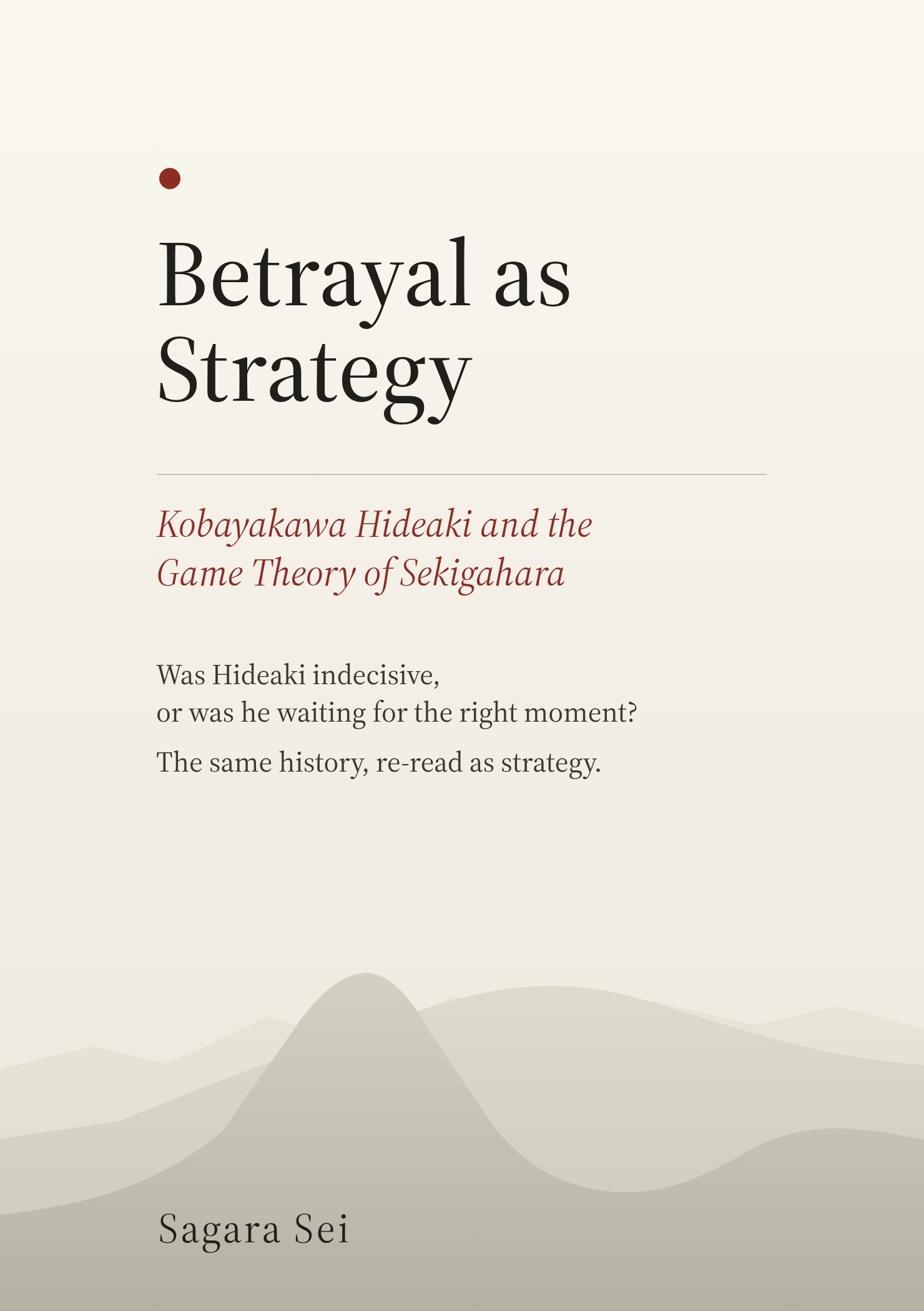
Cover of Betrayal as Strategy: Kobayakawa Hideaki and the Game Theory of Sekigahara. Click for the full-size JPEG (1480 × 2100).
Map 1: The Road to Sekigahara: Movements of the Commanders
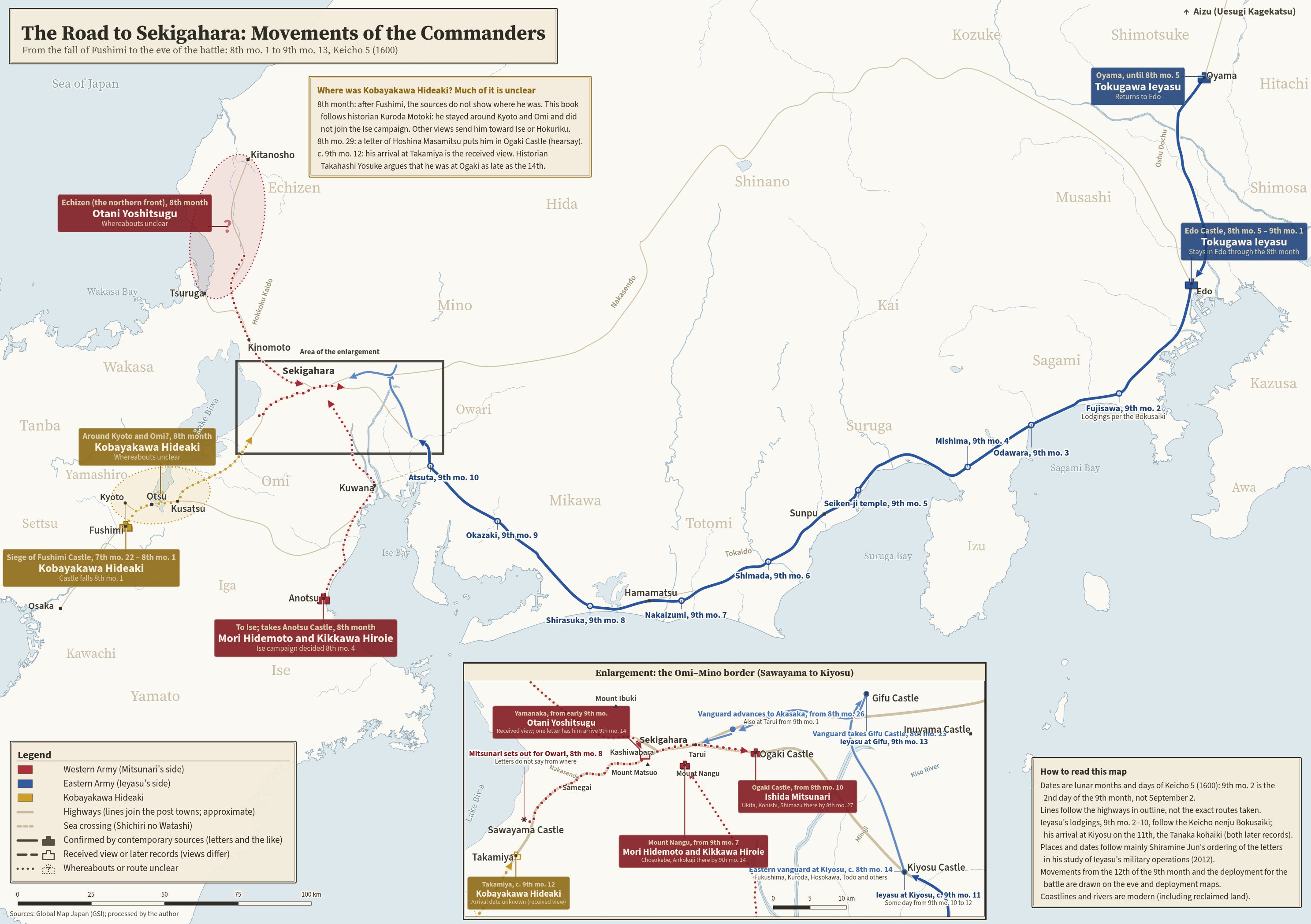
The movements of the commanders from the siege of Fushimi Castle to Sekigahara (at the end of Chapter 2).
Map 2: The Eve of Sekigahara: Movements of the Commanders
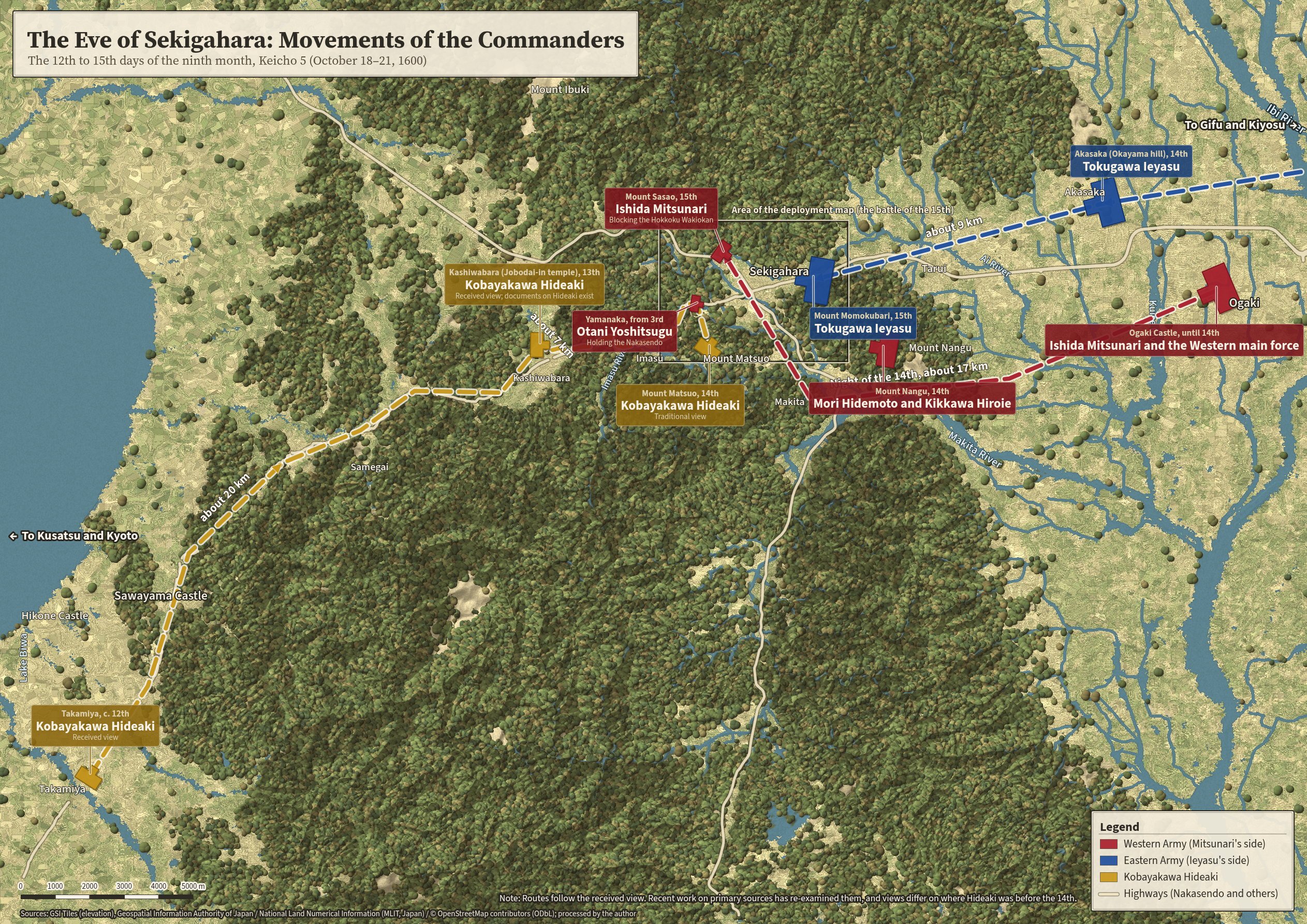
The movements of the commanders up to the eve of the battle, including the Kobayakawa march from Takamiya by way of Kashiwabara onto Mount Matsuo (at the end of Chapter 4).
Map 3: The Deployment at Sekigahara
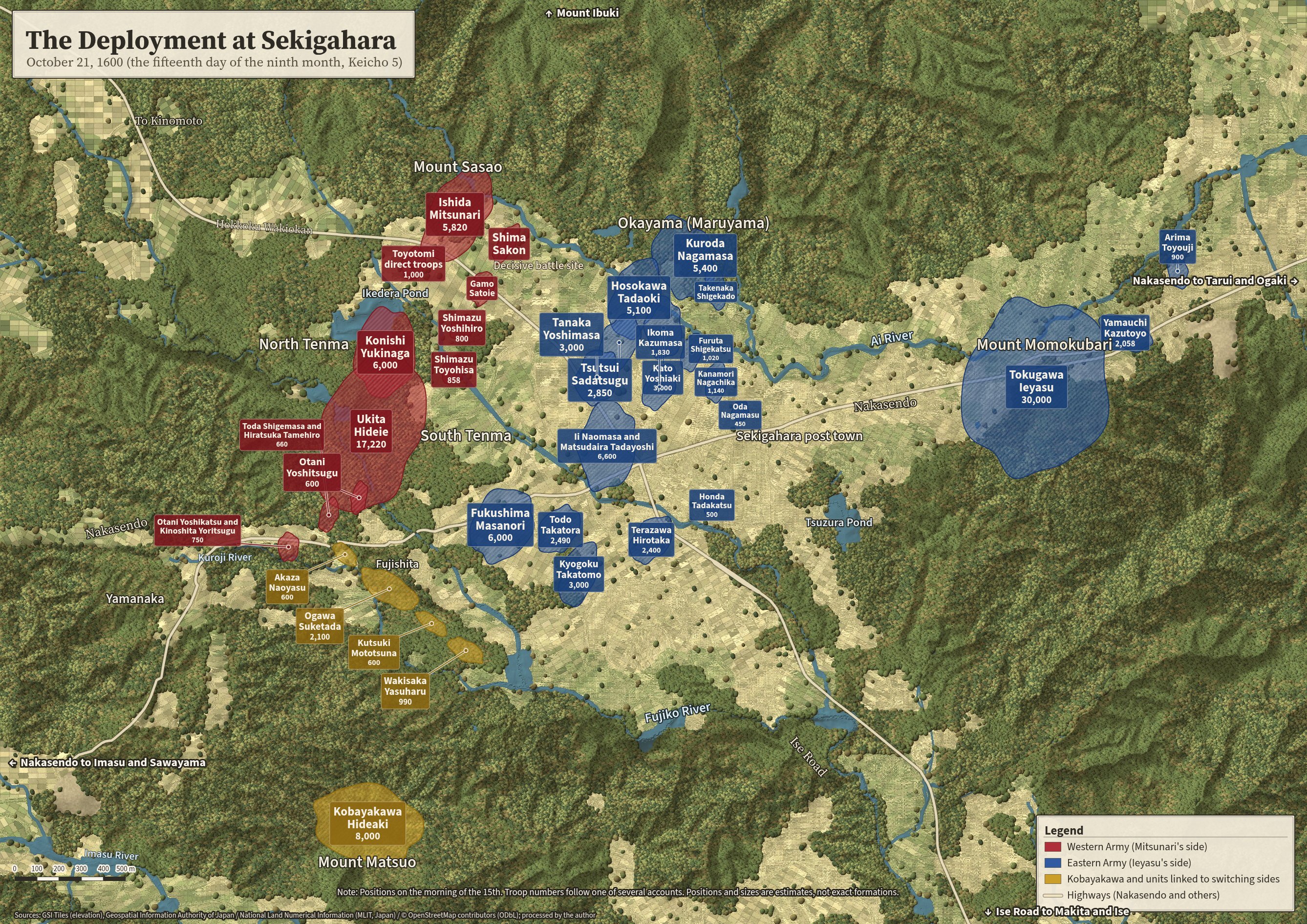
The positions on the 15th day of the 9th month of Keicho 5 (October 21, 1600) (at the end of Chapter 5). The positions of the units are estimates based on the received view (Evidence A-9).
Author
Sagara Sei (相良 静) rereads historical decisions through strategy, institutions and the structure of games. Author's page
There is no author photograph.
Contact
For interviews, image permissions and review copies (PDF or EPUB), write to press@sagara-sei.com.